

How Long Does it Take to Close a Commercial Property in Manila
Last Updated: August 03, 2026
The question every commercial buyer asks early and every seller asks anxiously is the same: how long will this take? The honest answer for a Metro Manila commercial transaction is three to six months from accepted offer to registered title, and longer where the property carries complications. Buyers who plan for six weeks are not being optimistic; they are working from a residential timetable that does not apply.

Understanding where the time goes is more useful than knowing the total. Commercial transactions in Manila do not run slowly because any single step is slow. They run slowly because a sequence of independent processes, corporate authorization, title verification, tax computation and payment, and registration across three separate government offices, must be completed in order, and each one waits for the last. This article maps that sequence, identifies where delays reliably occur, and sets out what parties can realistically compress.
The Overall Shape of a Commercial Transaction
A Metro Manila commercial deal moves through five broad phases. Sourcing and preliminary negotiation establishes the parties and the indicative terms. Due diligence verifies the property and the seller. Documentation converts agreement into binding instruments. Tax clearance obtains the Bureau of Internal Revenue's certification that transfer taxes have been settled. Registration transfers title at the Registry of Deeds and updates the assessor's records.
The first three phases are within the parties' control and can be accelerated by preparation. The last two are largely governed by government processing and are compressed principally by submitting complete documentation the first time. This is why experienced practitioners invest disproportionate effort in document preparation: an incomplete submission at the BIR does not add a day to the timetable, it adds weeks.
Phase One: Sourcing and Preliminary Negotiation
For a buyer with a defined requirement and an active broker, identifying suitable commercial property in Metro Manila typically takes four to twelve weeks. Office and retail space in established districts moves faster because inventory is deeper and comparables are abundant. Industrial land, large-format warehouse capacity, and development sites take longer because the inventory is thinner and much of it never reaches public listing.
A substantial and largely invisible share of this period is consumed by unproductive viewings, properties that have already transacted, listings circulated without the owner's authority, and asking prices unsupported by any comparable evidence. Buyers who insist on confirming that a listing is current and that the party offering it holds a valid Authority to Sell or Authority to Negotiate before scheduling an inspection routinely compress this phase materially.
The phase concludes with a Letter of Intent. An LOI is generally non-binding as to the transaction but establishes price, payment structure, the diligence period, and any exclusivity granted to the buyer. Negotiating the LOI carefully is time well spent, because ambiguity here resurfaces as delay later.
Phase Two: Due Diligence
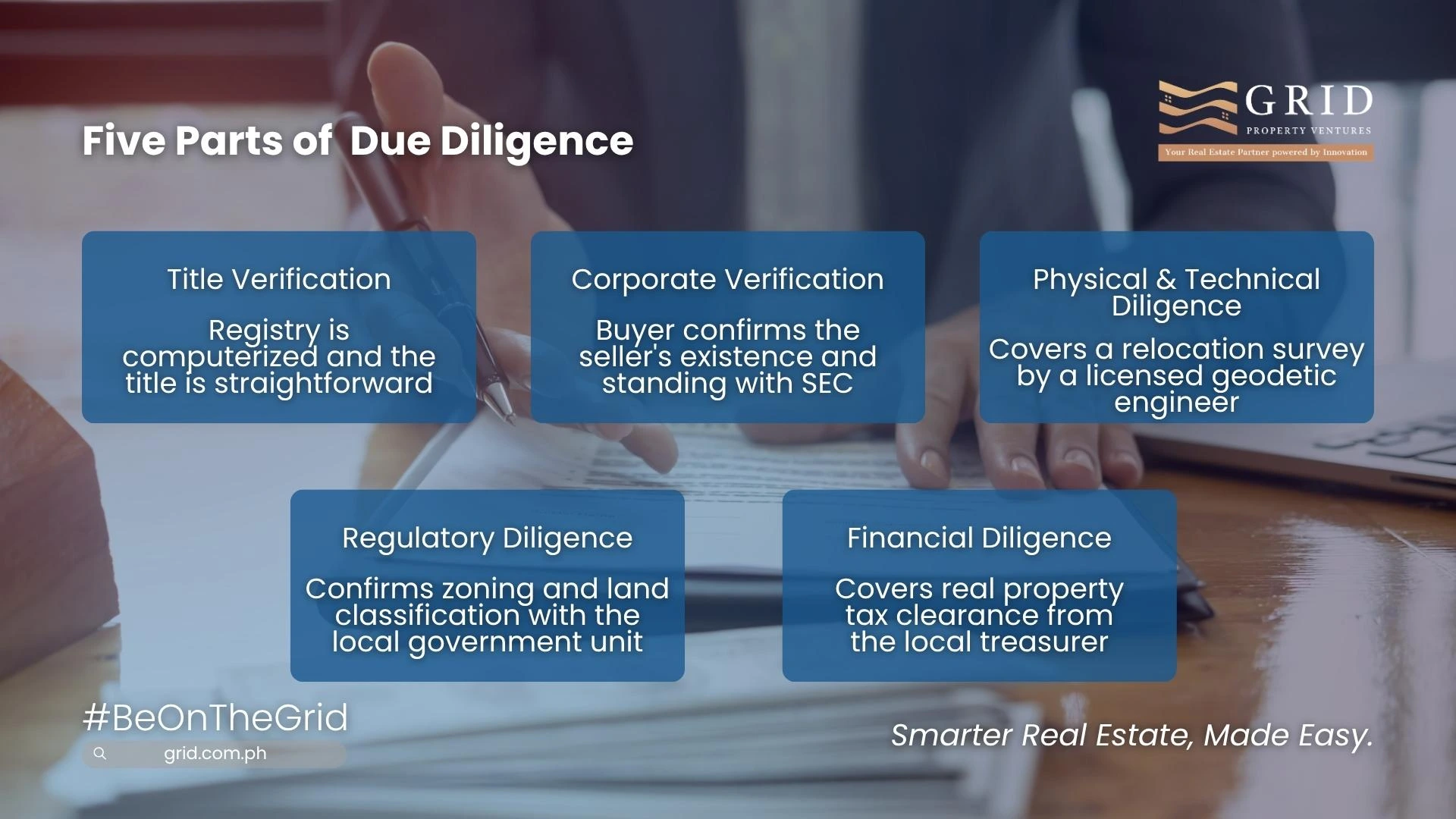
Commercial due diligence in Metro Manila typically occupies four to eight weeks and runs across several parallel tracks.
Title verification requires obtaining a Certified True Copy from the Registry of Deeds, reading the memorandum of encumbrances, and resolving any live annotation. Where the Registry is computerized and the title is straightforward, the copy is available within days. Where an annotation requires cancellation, a settled mortgage never formally released, for instance, the resolution can add a month or more on its own.
Corporate verification applies wherever either party is a corporation, which in commercial transactions is most of the time. The buyer confirms the seller's existence and standing with the Securities and Exchange Commission and obtains the board resolution or secretary's certificate authorizing the sale and designating the signatory. Where the seller's board meets quarterly, obtaining a specific authorizing resolution can become the critical path item in the entire transaction.
Physical and technical diligence covers a relocation survey by a licensed geodetic engineer confirming that registered boundaries match occupation on the ground, structural and building systems assessment for improved property, and environmental review where prior industrial use raises contamination questions.
Regulatory diligence confirms zoning and land classification with the local government unit, verifies that the intended use is permitted, and identifies whether an Environmental Compliance Certificate or other clearance will be required for the buyer's development plans.
Financial diligence covers real property tax clearance from the local treasurer, confirmation that association dues are current where the property sits within a condominium or estate, and review of existing leases where the property is acquired with tenants in place.
Phase Three: Documentation
Converting an agreed deal into binding documents takes two to four weeks where the structure is conventional and longer where it is not.
The principal instrument is the Deed of Absolute Sale, which must be notarized to be registrable. Where payment is staged, the parties may instead execute a Contract to Sell, under which title transfers only upon full payment, a structurally different arrangement with different consequences and one that should never be conflated with a deed of sale.
Corporate parties will also require executed board resolutions and secretary's certificates. Where a party acts through a representative, a Special Power of Attorney is needed, and where it is executed abroad, it must be authenticated through the nearest Philippine consulate or apostilled, which adds weeks that are easy to overlook when planning.
Phase Four: Bureau of Internal Revenue Clearance
This phase is the single most common source of delay in Philippine property transactions, and it typically runs four to twelve weeks.
The seller is generally liable for capital gains tax on the sale of a capital asset, computed on the higher of gross selling price or fair market value, and this is due within thirty days of notarization. Documentary stamp tax is due by the fifth day of the month following notarization. Where the property is an ordinary asset held by a business, creditable withholding tax applies instead of capital gains tax, and value-added tax may apply to the transaction, a materially different computation that should be established with a tax adviser before the deed is signed rather than afterwards.
Once taxes are paid, the parties apply to the BIR for a Certificate Authorizing Registration. No transfer can be registered without it. Processing time varies significantly between Revenue District Offices, and the most frequent cause of extended delay is an incomplete or inconsistent submission, a discrepancy between the deed and the title, a missing tax clearance, or a valuation the examiner disputes. Each deficiency triggers a return of the file and a fresh queue.
Phase Five: Transfer Tax and Registration
With the CAR issued, the transfer tax payable to the local government unit is settled, generally within sixty days of the date of the deed. The rate varies by locality within the limits set by the Local Government Code.
With the CAR issued, the transfer tax payable to the local government unit is settled, generally within sixty days of the date of the deed. The rate varies by locality within the limits set by the Local Government Code.
Registration at the Registry of Deeds follows. The buyer submits the notarised deed, the owner's duplicate certificate, the CAR, proof of transfer tax and real property tax payment, and supporting corporate documents. The Registry cancels the existing certificate and issues a new Transfer Certificate of Title or Condominium Certificate of Title in the buyer's name. Where documentation is complete and the Registry is computerized, this commonly takes two to four weeks.
The final step, frequently forgotten in transaction planning, is updating the tax declaration with the local assessor so that future real property tax assessments issue in the buyer's name. This takes a further one to three weeks and is the buyer's responsibility.
Registration at the Registry of Deeds follows. The buyer submits the notarised deed, the owner's duplicate certificate, the CAR, proof of transfer tax and real property tax payment, and supporting corporate documents. The Registry cancels the existing certificate and issues a new Transfer Certificate of Title or Condominium Certificate of Title in the buyer's name. Where documentation is complete and the Registry is computerized, this commonly takes two to four weeks.
The final step, frequently forgotten in transaction planning, is updating the tax declaration with the local assessor so that future real property tax assessments issue in the buyer's name. This takes a further one to three weeks and is the buyer's responsibility.
Where the Time Actually Goes
Aggregating these phases produces a realistic range of approximately four to six months for a straightforward Metro Manila commercial transaction, with the BIR clearance phase and due diligence together accounting for the majority of elapsed time.
Certain circumstances extend this materially. Properties held by estates cannot transfer until settlement is complete and estate tax is paid. Titles carrying un-cancelled annotations require formal resolution. Corporate sellers with dispersed shareholders or infrequent board meetings introduce authorization delay. Any dispute over property boundaries requires survey resolution before registration. And where land classification must be converted to permit the buyer's intended use, the conversion process operates on its own timetable entirely.
What Can Realistically Be Compressed
Preparation compresses timelines far more effectively than pressure does. Sellers who assemble the complete document set before going to market, certified true copy, tax declaration, real property tax clearance, board resolution, and corporate registration documents, remove weeks from the process. Buyers who confirm authority to sell before inspecting property eliminate the wasted cycles that inflate the sourcing phase.
Engaging counsel and a tax adviser at the letter of intent stage rather than at deed preparation is the other reliable accelerator. The structural questions , capital asset or ordinary asset, VAT treatment, deed of sale or contract to sell, who bears which cost, determine the tax computation and the documentary requirements. Resolving them early avoids the far more expensive exercise of unwinding an executed document.

What cannot be compressed is government processing time. Expediting arrangements offered informally at any stage of this process should be declined; beyond the legal exposure, they do not reliably work, and a transaction record that will be scrutinized at the next sale is not worth compromising.
Most of the avoidable delay in a Philippine commercial transaction happens before the offer is made, in the weeks spent on listings that were never live or sellers who could not actually convey. Starting from inventory where identity and selling authority are confirmed at source removes that friction entirely. You can explore verified commercial listings across Metro Manila and the country's key growth corridors at The Grid Property Ventures, the Philippines' smartest real-estate platform.