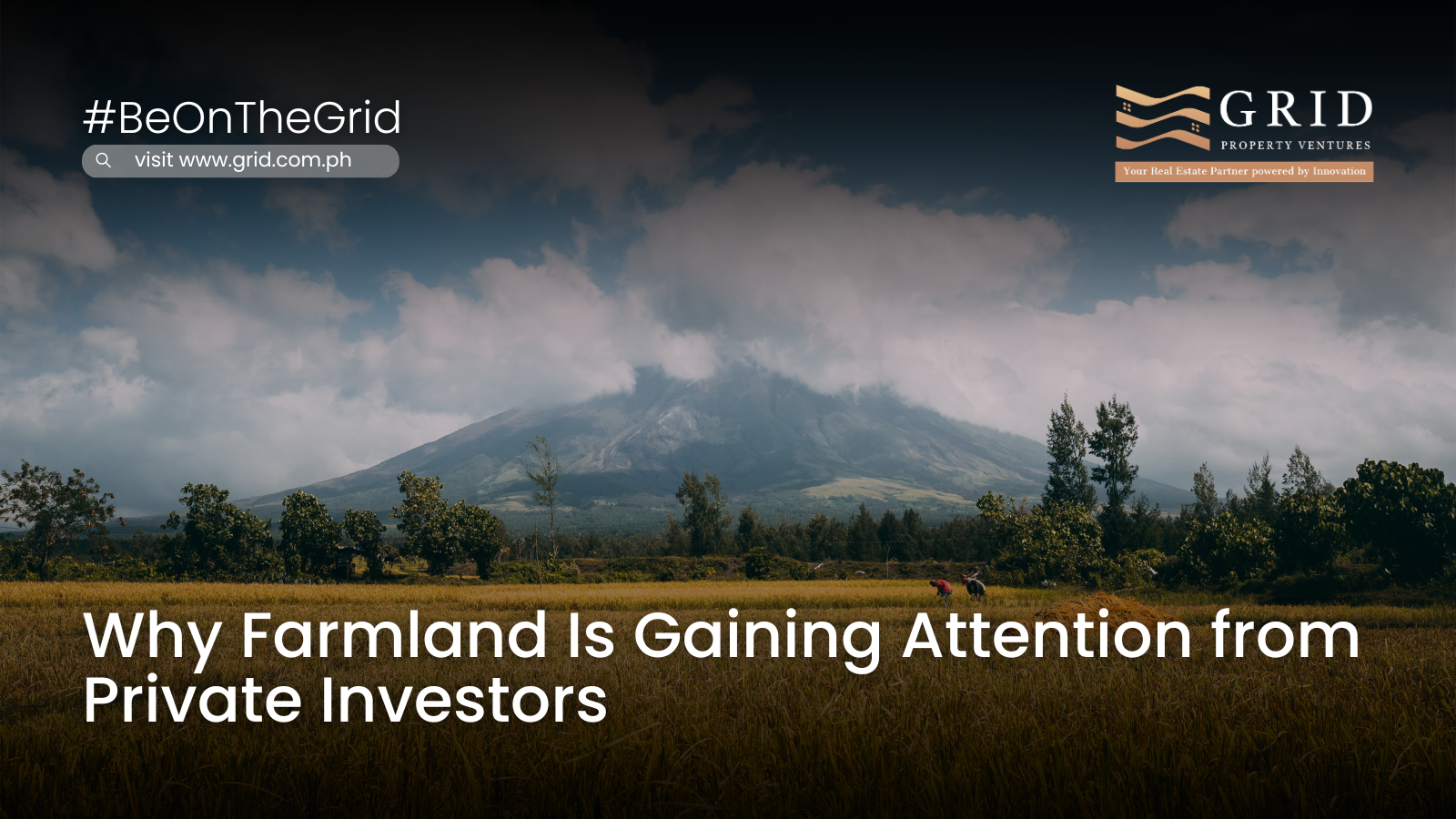
Why Farmland Is Gaining Attention from Private Investors
Last Updated: July 08, 2026
Get on the grid - it starts with a demo.
Farmland is no longer just for farmers.
Over the past few years, private investors in the Philippines have started paying closer attention to agricultural land, not just as a long-term hold, but as a strategic asset.
What used to be overlooked is now being reconsidered.
And the reason is simple. Farmland checks multiple boxes that many other asset classes do not.
A Shift Toward Real Assets
Investor behavior has been changing.
There is growing interest in assets that are tangible, limited in supply, and less volatile than traditional markets. Farmland fits this profile.
Unlike stocks or speculative real estate plays, farmland has intrinsic value. It produces something. It serves a function. And it is not easily replicated.
This makes it attractive for investors who are looking to balance risk while still maintaining growth potential.
Land Scarcity Is Becoming More Obvious
One of the biggest drivers of interest in farmland is scarcity.
As urban areas expand and infrastructure projects continue, more land is being converted for residential and commercial use. This reduces the supply of available agricultural land over time.
At the same time, population growth continues to increase demand for food production.
This imbalance creates long-term pressure on farmland value.
Investors are recognizing this early. They understand that farmland is not just another property type. It is a finite resource that becomes more valuable as supply tightens.
Income Potential Is No Longer Limited
Historically, farmland income was tied to traditional farming, which often meant lower and less predictable returns.
That is no longer the case.
Today, farmland can generate income through multiple channels:
- Leasing to farmers or agri-business operators
- Profit-sharing partnerships for commercial farming
- High-value crop production such as specialty produce
- Agri-tourism and recreational use
- Renewable energy projects like solar leasing
This diversification of income streams makes farmland more attractive to investors who want both cash flow and long-term appreciation.
It also reduces reliance on a single source of income.
Lower Entry Points Compared to Urban Property
Another factor driving interest is accessibility.
Compared to urban real estate, farmland often has a lower entry price. This allows investors to acquire larger parcels or multiple properties without the same level of capital required in city markets.
For private investors, this creates flexibility.
They can diversify across locations, experiment with different land use strategies, or hold larger positions in high-potential areas.
Lower entry points do not mean lower potential. In many cases, farmland located in emerging areas has significant upside.
Infrastructure Is Expanding Farmland Value
Infrastructure development is not just benefiting residential and commercial properties.
It is also increasing the value of farmland.
Improved roads, transport systems, and logistics networks make it easier to move goods from farms to markets. This enhances the viability of agricultural operations and increases demand for well-located farmland.
For investors, this means farmland is no longer isolated.
It is becoming integrated into broader economic activity, which strengthens its value proposition.
Farmland as a Hedge
In uncertain economic conditions, investors often look for assets that can act as a hedge.
Farmland has historically been viewed as a stable store of value. It tends to be less sensitive to short-term market fluctuations and can provide consistent returns when managed properly.
While no investment is risk-free, farmland offers a level of stability that is appealing, especially when other markets are unpredictable.
This is another reason why private investors are starting to include it in their portfolios.
The Role of Long-Term Thinking
Farmland is not a quick flip investment.
It rewards patience.
Investors who are entering this space understand that returns are built over time through a combination of income generation and appreciation.
This aligns well with long-term strategies.
As land becomes scarcer and demand for food and alternative land use increases, the value of farmland is expected to strengthen.
For those willing to take a longer view, the potential is clear.
What Investors Look for in Farmland
Not all farmland is equal.
Private investors are selective, and they focus on specific characteristics when evaluating opportunities.
These typically include:
- Accessibility and road infrastructure
- Proximity to markets and distribution networks
- Soil quality and water availability
- Size and scalability of the land
- Potential for alternative uses beyond traditional farming
Land that checks multiple boxes is far more likely to attract serious interest.
For landowners, understanding these criteria can help position a property more effectively.
The Risks Still Matter
Despite the growing interest, farmland is not without its challenges.
Investors are aware of risks such as:
- Regulatory and zoning restrictions
- Dependence on operators or tenants
- Weather and environmental factors
- Liquidity compared to urban real estate
These factors do not eliminate interest, but they do influence how investors approach deals.
Properties that address or mitigate these risks tend to stand out.
Why This Matters for Landowners
If you own farmland, this shift in investor behavior is important.
It means your property may have more potential buyers than before, including individuals and groups who are not traditional farmers.
But attracting these buyers requires the right positioning.
Pricing, documentation, and a clear understanding of the property’s potential all play a role in generating serious interest.
Ignoring this trend could mean missing out on opportunities that are already developing in the market.
Farmland Is No Longer an Afterthought
What used to be seen as a passive asset is now being viewed as a strategic one.
Private investors are paying attention. They are allocating capital. And they are looking for properties that align with their long-term goals.
This is not a temporary shift.
It reflects a broader change in how land is valued and utilized.
For landowners, this creates a chance to engage with a new class of buyers and unlock value that may not have been obvious before.
Turn Investor Interest Into Real Opportunity
If you are considering selling your farmland or exploring ways to position it for investment, the timing matters.
At GRID, we help landowners connect with serious buyers and investors who are actively looking for opportunities in agricultural land.
From pricing and positioning to identifying the right buyer profile, we focus on turning interest into real transactions.
Reach out today and see how your farmland can attract the kind of attention that leads to actual deals.